

IF THE REST WERE PASSIVE ONLY THE RULING CLASS NEEDED TO BE KNOWN
Part II on Walter Lippmann’s writing Public Opinion plus a few surprises

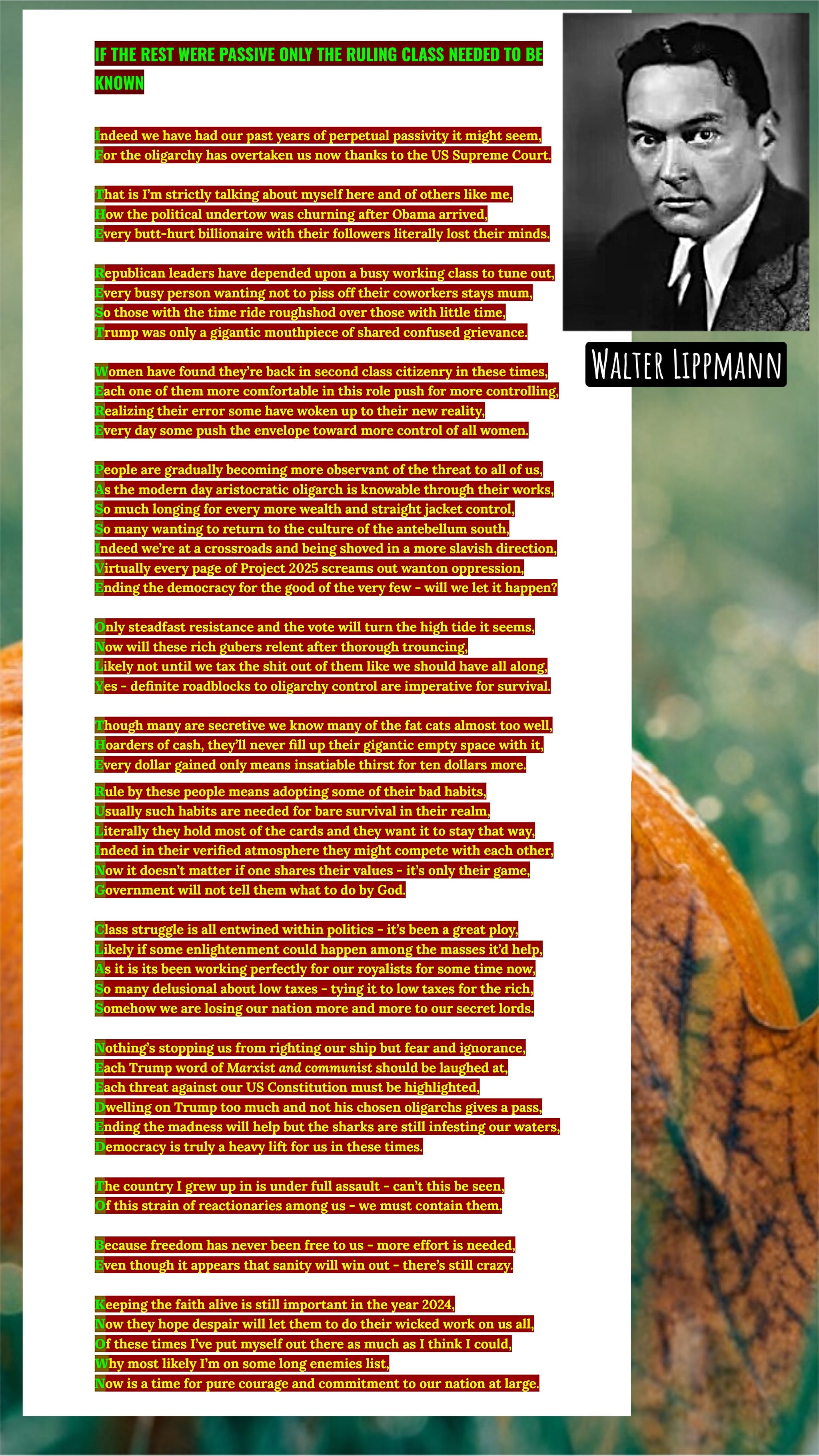
IF THE REST WERE PASSIVE ONLY THE RULING CLASS NEEDED TO BE KNOWN
Indeed we have had our past years of perpetual passivity it might seem,
For the oligarchy has overtaken us now thanks to the US Supreme Court.
That is I’m strictly talking about myself here and of others like me,
How the political undertow was churning after Obama arrived,
Every butt-hurt billionaire with their followers literally lost their minds.
Republican leaders have depended upon a busy working class to tune out,
Every busy person wanting not to piss off their coworkers stays mum,
So those with the time ride roughshod over those with little time,
Trump was only a gigantic mouthpiece of shared, confused grievance.
Women have found they’re back in second class citizenry in these times,
Each one of them more comfortable in this role push for more controlling,
Realizing their error some have woken up to their new reality,
Every day some push the envelope toward more control of all women.
People are gradually becoming more observant of the threat to all of us,
As the modern day aristocratic oligarch is knowable through their works,
So much longing for every more wealth and straight jacket control,
So many wanting to return to the culture of the antebellum south,
Indeed we’re at a crossroads and being shoved in a more slavish direction,
Virtually every page of Project 2025 screams out wanton oppression,
Ending the democracy for the good of the very few - will we let it happen?
Only steadfast resistance and the vote will turn the high tide it seems,
Now will these rich gubers relent after a thorough trouncing,
Likely not until we tax the shit out of them like we should have all along,
Yes - definite roadblocks to oligarchy control are imperative for survival.
Though many are secretive we know many of the fat cats almost too well,
Hoarders of cash, they’ll never fill up their gigantic empty space with it,
Every dollar gained only means insatiable thirst for ten dollars more.
Rule by these people means adopting some of their bad habits,
Usually such habits are needed for bare survival in their realm,
Literally they hold most of the cards and they want it to stay that way,
Indeed in their verified atmosphere they might compete with each other,
Now it doesn’t matter if one shares their values - it’s only their game,
Government will not tell them what to do by God.
Class struggle is all entwined within politics - it’s been a great ploy,
Likely if some enlightenment could happen among the masses it’d help,
As it is its been working perfectly for our royalists for some time now,
So many delusional about low taxes - tying it to low taxes for the rich,
Somehow we are losing our nation more and more to our secret lords.
Nothing’s stopping us from righting our ship but fear and ignorance,
Each Trump word of Marxist and communist should be laughed at,
Each threat against our US Constitution must be highlighted,
Dwelling on Trump too much and not his chosen oligarchs gives a pass,
Ending the madness will help but the sharks are still infesting our waters,
Democracy is truly a heavy lift for us in these times.
The country I grew up in is under full assault - can’t this be seen,
Of this strain of reactionaries among us - we must contain them.
Because freedom has never been free to us - more effort is needed,
Even though it appears that sanity will win out - there’s still crazy.
Keeping the faith alive is still important in the year 2024,
Now they hope despair will let them to do their wicked work on us all,
Of these times I’ve put myself out there as much as I think I could,
Why most likely I’m on some long enemies list,
Now is a time for pure courage and commitment to our nation at large.
IF THE REST WERE PASSIVE ONLY THE RULING CLASS NEEDED TO BE KNOWN
“…as long as the rest of mankind was passive, the only characters one needed to know were the characters of men in the ruling class.”
Walter Lippmann (September 23, 1889 December 14, 1974) was an American writer, reporter, and political commentator. With a career spanning 60 years, he is famous for being among the first to introduce the concept of the Cold War, coining the term "stereotype" in the modern psychological meaning, as well as critiquing media and democracy in his newspaper column and several books, most notably his 1922 Public Opinion.
BY
WALTER LIPPMANN*
CHAPTER XVI
THE SELF-CENTERED MAN
Part II.
2. Continued
Royalists were sure that kings were born to govern. Alexander Hamilton thought that while "there are strong minds in every walk of life… the representative body, with too few exceptions to have any influence on the spirit of the government, will be composed of landholders, merchants, and men of the learned professions." [Footnote: The Federalist, Nos. 35, 36. Cf. comment by Henry Jones Ford in his Rise and Growth of American Politics. Ch. V.] Jefferson thought the political faculties were deposited by God in farmers and planters, and sometimes spoke as if they were found in all the people. [Footnote: See below p. 268.] 13. The main premise was the same: to govern was an instinct that appeared, according to your social preferences, in one man or a chosen few, in all males, or only in males who were white and twenty-one, perhaps even in all men and all women.
In deciding who was most fit to govern, knowledge of the world was taken for granted. 14. The aristocrat believed that those who dealt with large affairs possessed the instinct, the democrats asserted that all men possessed the instinct and could therefore deal with large affairs. It was no part of political science in either case to think out how knowledge of the world could be brought to the ruler. If you were for the people you did not try to work out the question of how to keep the voter informed. By the age of twenty-one he had his political faculties. What counted was a good heart, a reasoning mind, a balanced judgment. These would ripen with age, but it was not necessary to consider how to inform the heart and feed the reason. Men took in their facts as they took in their breath.
3
15. But the facts men could come to possess in this effortless way were limited. They could know the customs and more obvious character of the place where they lived and worked. But the outer world they had to conceive, and they did not conceive it instinctively, nor absorb trustworthy knowledge of it just by living. Therefore, the only environment in which spontaneous politics were possible was one confined within the range of the ruler's direct and certain knowledge. There is no escaping this conclusion, wherever you found government on the natural range of men's faculties. "If," as Aristotle said, [Footnote: Politics, Bk. VII, Ch. 4.] "the citizens of a state are to judge and distribute offices according to merit, then they must know each other's characters; where they do not possess this knowledge, both the election to offices and the decision of law suits will go wrong."
Obviously this maxim was binding upon every school of political thought. But it presented peculiar difficulties to the democrats. 16. Those who believed in class government could fairly claim that in the court of the king, or in the country houses of the gentry, men did know each other's characters, and as long as the rest of mankind was passive, the only characters one needed to know were the characters of men in the ruling class. 17. But the democrats, who wanted to raise the dignity of all men, were immediately involved by the immense size and confusion of their ruling class—the male electorate. Their science told them that politics was an instinct, and that the instinct worked in a limited environment. Their hopes bade them insist that all men in a very large environment could govern. In this deadly conflict between their ideals and their science, the only way out was to assume without much discussion that the voice of the people was the voice of God.
The paradox was too great, the stakes too big, their ideal too precious for critical examination. They could not show how a citizen of Boston was to stay in Boston and conceive the views of a Virginian, how a Virginian in Virginia could have real opinions about the government at Washington, how Congressmen in Washington could have opinions about China or Mexico. For in that day it was not possible for many men to have an unseen environment brought into the field of their judgment. There had been some advances, to be sure, since Aristotle. There were a few newspapers, and there were books, better roads perhaps, and better ships. 18. But there was no great advance, and the political assumptions of the Eighteenth Century had essentially to be those that had prevailed in political science for two thousand years. The pioneer democrats did not possess the material for resolving the conflict between the known range of man's attention and their illimitable faith in his dignity.
Their assumptions antedated not only the modern newspaper, the world-wide press services, photography and moving pictures, but, what is really more significant, they antedated measurement and record, quantitative and comparative analysis, the canons of evidence, and the ability of psychological analysis to correct and discount the prejudices of the witness. 19. I do not mean to say that our records are satisfactory, our analysis unbiased, our measurements sound. I do mean to say that the key inventions have been made for bringing the unseen world into the field of judgment. They had not been made in the time of Aristotle, and they were not yet important enough to be visible for political theory in the age of Rousseau, Montesquieu, or Thomas Jefferson. In a later chapter I think we shall see that even in the latest theory of human reconstruction, that of the English Guild Socialists, all the deeper premises have been taken over from this older system of political thought.
20. That system, whenever it was competent and honest, had to assume that no man could have more than a very partial experience of public affairs. In the sense that he can give only a little time to them, that assumption is still true, and of the utmost consequence. But ancient theory was compelled to assume, not only that men could give little attention to public questions, but that the attention available would have to be confined to matters close at hand. 21. It would have been visionary to suppose that a time would come when distant and complicated events could conceivably be reported, analyzed, and presented in such a form that a really valuable choice could be made by an amateur. That time is now in sight. 22. There is no longer any doubt that the continuous reporting of an unseen environment is feasible. It is often done badly, but the fact that it is done at all shows that it can be done, and the fact that we begin to know how badly it is often done, shows that it can be done better. With varying degrees of skill and honesty distant complexities are reported every day by engineers and accountants for business men, by secretaries and civil servants for officials, by intelligence officers for the General Staff, by some journalists for some readers. These are crude beginnings but radical, far more radical in the literal meaning of that word than the repetition of wars, revolutions, abdications and restorations; as radical as the change in the scale of human life which has made it possible for Mr. Lloyd George to discuss Welsh coal mining after breakfast in London, and the fate non of the Arabs before dinner in Paris.
For the possibility of bringing any aspect of human affairs within the range of judgment breaks the spell which has lain upon political ideas. 23. There have, of course, been plenty of men who did not realize that the range of attention was the main premise of political science. They have built on sand. They have demonstrated in their own persons the effects of a very limited and self-centered knowledge of the world. 24. But for the political thinkers who have counted, from Plato and Aristotle through Machiavelli and Hobbes to the democratic theorists, speculation has revolved around the self-centered man who had to see the whole world by means of a few pictures in his head.
13. The main premise was the same: to govern was an instinct that appeared, according to your social preferences, in one man or a chosen few, in all males, or only in males who were white and twenty-one, perhaps even in all men and all women.
This instinct to govern. To lead requires training certainly. Some are more gifted to lead than others. Some certainly have no business in a leadership role. Unfortunately many of these types seem to fail upward into leadership roles where they do damage. Trump may have some instinct to lead but as a malignant narcissist it is only to satisfy this overriding focus in the person. What’s in it for him is really the only question he might contemplate when trying to obtain leadership. There is of course a tremendous amount waiting for him personally if he should get back into power. The nation will the unfortunate recipient of great harm if he should pull it off. Trump is male and white and due to inheritance was able to fail upwards. Only the most willing sycophants surround him now, similar people undoubtedly to Trump. Trump was very careful to choose a white male as his running mate. He might fantasize that he is worthy of running the country and that only another white guy could possibly replace him. Hopefully the election will prove that we’ve advanced in our humanity to elect a non-white woman to the presidency.
14. The aristocrat believed that those who dealt with large affairs possessed the instinct, the democrats asserted that all men possessed the instinct and could therefore deal with large affairs. It was no part of political science in either case to think out how knowledge of the world could be brought to the ruler. If you were for the people you did not try to work out the question of how to keep the voter informed. By the age of twenty-one he had his political faculties. What counted was a good heart, a reasoning mind, a balanced judgment. These would ripen with age, but it was not necessary to consider how to inform the heart and feed the reason. Men took in their facts as they took in their breath.
“What counted was a good heart, a reasoning mind, a balanced judgment.” So in the past this was apparently thought by democrats to exist by age twenty one. This seems all quite ridiculous now perhaps. And supposedly the aristocrat had all the qualities just because he was an aristocrat. The simplification of the needed acumen no doubt shows the advancement in thought over time. As far as the first sentence in this paragraph, these qualities are important I suppose. I see none of these three qualities in Trump. A MAGA person would undoubtedly argue for all three in Trump, but truthfully I can see nothing of any of these in the man. And age has little bearing except for worsening the undiserable traits in Trump due to his dementia. I perhaps am prejudiced toward Harris and Walz in possessing all three as I truly think this is true. I think both have many more disarable traits for leadership other than theses three. Intelligence most certainly, and the ability to use reason to complex problems.
15. But the facts men could come to possess in this effortless way were limited. They could know the customs and more obvious character of the place where they lived and worked. But the outer world they had to conceive, and they did not conceive it instinctively, nor absorb trustworthy knowledge of it just by living. Therefore, the only environment in which spontaneous politics were possible was one confined within the range of the ruler's direct and certain knowledge.
Certainly the spread of knowledge nowadays is much greater than in previous times. And I would argue that the spontaneous politics mentioned above still is confined to one’s base of knowledge. What a person has experienced, read about, studied etc., will contribute to their ability to deal with problems which might arise. Trump is severely at a disadvantage in this all because he has never read. This should have been the first clue that he was very unqualified for the presidency with Americans. But honestly many Americans don’t read either and associate this with being an “elite.” And they have been trained to dislike the elite. Hence someone like Trump can become president. It all seems very ignorant of Americans but that’s how it currently is.
16. Those who believed in class government could fairly claim that in the court of the king, or in the country houses of the gentry, men did know each other's characters, and as long as the rest of mankind was passive, the only characters one needed to know were the characters of men in the ruling class.
The acrostic verse above covers this sentence substantially.
17. But the democrats, who wanted to raise the dignity of all men, were immediately involved by the immense size and confusion of their ruling class—the male electorate. Their science told them that politics was an instinct, and that the instinct worked in a limited environment. Their hopes bade them insist that all men in a very large environment could govern. In this deadly conflict between their ideals and their science, the only way out was to assume without much discussion that the voice of the people was the voice of God.
“The voice of the people is the voice of God.” I’m uncertain how to unpack this statement although in many ways I do believe it. In Alcoholics Anynomous there are often people in need of a concept of a higher power to help them fight against their addiction. To many people, old timers even, the group is still their personal higher power. I would suggest that in governance that it might really be the same way. Of course when millions are involved different strategies must be used but I think on the whole in the Democratic Party the group still matters. The authoritarians in the Republican Party depend upon much fewer voices. At this time it’s Trump only. Perhaps Trump serves as a higher divine political power for these folks. I really don’t understand it but perhaps that’s what they do? The Democratic Party still largely wants to raise the dignity of all men. The Republican Party only strives for certain groups to be blessed.
18. But there was no great advance, and the political assumptions of the Eighteenth Century had essentially to be those that had prevailed in political science for two thousand years. The pioneer democrats did not possess the material for resolving the conflict between the known range of man's attention and their illimitable faith in his dignity.
“The pioneer democrats did not possess the material for resolving the conflict between the known range of man's attention and their illimitable faith in his dignity.”
This sentence intrigues me. A question came to my mind. In the nineteenth century was it finally resolved this contest between man’s attention and illimitable faith in his (or her) dignity? Are we still struggling with this with the spread of MAGA? As attention is diverted now so much. Disinformation and misinformation abounds. And even the concept of human dignity is not necessarily in the minds and hearts of all our people. Many will argue that it is, and they remember “content of character” part from Reverend Martin King’s speech but most likely in many cases it’s only empty words. Are we still in the realm of the first two thousand years now? My thoughts are that we have advanced but Trump and MAGA is resisting our change.
19. I do not mean to say that our records are satisfactory, our analysis unbiased, our measurements sound. I do mean to say that the key inventions have been made for bringing the unseen world into the field of judgment. They had not been made in the time of Aristotle, and they were not yet important enough to be visible for political theory in the age of Rousseau, Montesquieu, or Thomas Jefferson.
As discussed above, I think we may be swimming now in information. We probably have too much now for the average person to navigate through. I might contend that due to the information stream, including many falsehoods, we are going backwards from where we were in about 1975 in my lifetime. Three news networks, the fairness doctrine, perhaps a better educated audience. They are very visable now, our records, but it’s in actually having trust in them where we fail. One has to be very careful now. Too many are not careful in their information. Many deal in conspiracy theory as there is money in it. Many tell lies also because truth is not as important as power to them.
20. That system, whenever it was competent and honest, had to assume that no man could have more than a very partial experience of public affairs. In the sense that he can give only a little time to them, that assumption is still true, and of the utmost consequence.
“…that assumption is still true, and of the utmost consequence.”
Lippmann was writing this in the early 192Os. It might seem that Donald Trump won the electrole college in 2016 in that he didn’t know much about government. He certainly still does not know that much about it, except where rules can be bent to his will, and at this point the US Constitution is his direct enemy obviously for what he has in mind. With the Trump the more he might comprehend the more damage he will do. I would say that both Harris and Walz have much more than “very partial experience of public affairs.” So I’m unsure if this is true in the case of Harris and Walz. Trump and Vance both are newcomers to public office so it’s certainly true about them. Trump was president for four years but spent at least a third of his time on his own golf courses then. His understanding is very limited of public affairs, except for how to weaponize it all.
21. It would have been visionary to suppose that a time would come when distant and complicated events could conceivably be reported, analyzed, and presented in such a form that a really valuable choice could be made by an amateur. That time is now in sight.
Have we obtained this condition. I might suggest that many progressive ideas have first been put into action in many of the European democratic socialists governments. Bernie Sanders is astute to many of these ideas and has proposed them here. In piecemeal fashion some are becoming reality on occasion. During the pandemic the child tax credit found a temporary place and millions of children were lifted out of poverty. It all sunsetted in time, a positive accomplishment but was tried at least. Such legislation is only possible with a full Democratic majority in congress as such programs are anathema to the Republicans. I’m not sure if “amateurs” are on the forefront however. One must be knowledgeable of such things. The expertise required for such an endeavor might take it out of the realm of someone like me who is an amateur. But I can recognize a good idea when I see it I suppose. Trying to get into law requires more juice than I might have however. I can help certainly though, as can most people who might read this.
22. There is no longer any doubt that the continuous reporting of an unseen environment is feasible. It is often done badly, but the fact that it is done at all shows that it can be done, and the fact that we begin to know how badly it is often done, shows that it can be done better. With varying degrees of skill and honesty distant complexities are reported every day by engineers and accountants for business men, by secretaries and civil servants for officials, by intelligence officers for the General Staff, by some journalists for some readers.
“With varying degrees of skill and honesty distant complexities are reported every day by engineers and accountants for business men, by secretaries and civil servants for officials, by intelligence officers for the General Staff, by some journalists for some readers.”
“With varying degrees of skill and honesty…”. My mind goes to climate change. Indeed there are degrees of “honesty” among engineers about manmade climate change. Some are paid to spread disinformation on it. It’s been going on for many decades. Professional prostitution (my apologies to actual sex workers) is what I consider it and in my world such individuals would be stripped of their professional licenses. I’m convinced that down the road not too much further this will begin to happen. Professional ostracism might have some effect on such behavior, but I guess I’m unsure if it actually might eventually happen. Engineers are almost always conservatives, whatever that might actually mean right now.
23. There have, of course, been plenty of men who did not realize that the range of attention was the main premise of political science. They have built on sand. They have demonstrated in their own persons the effects of a very limited and self-centered knowledge of the world.
“They have demonstrated in their own persons the effects of a very limited and self-centered knowledge of the world.”
Lights to body openings, drinking bleach, horse paste, sharpies showing a hurricane’s path, nucking a hurricane, aircraft carrier propulsion systems, sharks and batteries, etc. We are all aware of Trump’s ignorance in science. I suspect even the most ardent MAGA might agree. I wouid say he epitomizes limited and self-centered knowledge in nearly everything he might decide to take a stab at. His range of attention is very narrow. Harris and Walz both apparently not malignant narcissists both understand what they don’t know and will easily seek out expertise when needed. Trump being the narcissist will most likely not seek out expertise, instead choosing a sycophant who will agree with whatever idea which might pop into his mind.
24. But for the political thinkers who have counted, from Plato and Aristotle through Machiavelli and Hobbes to the democratic theorists, speculation has revolved around the self-centered man who had to see the whole world by means of a few pictures in his head.
So I guess we’ve been dealing with “Trumps” for a very long time. I would guess on average they might not have outdid Trump, otherwise we might be an extinct species by this time. Would Walter Lippmann ever envision Trump as president. I’m mostly doubtful that he would have. But maybe he did. He speaks in very general terms in this book.
I was curious about greed in animal species. It might seem that perhaps it’s found outside of human beings. From the research below it is implied that altruistic sharing is a positive evolutionary adaptation among some species. I’m unsure if the information from the study below answered my question but it seems to shine a light on it nonetheless.
Generosity, selfishness and exploitation as optimal greedy strategies for resource sharing
Andrea Mazzolini, Antonio Celani
Journal of Theoretical Biology - January 2020
Introduction
The sharing of resources in animals can be defined as an active or passive transfer of food from one individual to another. Some examples are food division in primates, blood sharing in vampire bats, and cooperative breeding in birds and fishes. From an external human observer, this behavior really resembles an act of “generosity”. Indeed, once an individual has acquired some resources, it chooses to equalize them among the members of the community (or with a partner) instead of being “selfish” and having a larger income. Resource division can be viewed as an instance of animal cooperation and biological altruism, subjects that have a long tradition in evolutionary biology. Darwin himself already noticed that altruism seems to be in contrast with the natural selection theory, since the altruistic act consists in a decrease of the donor fitness. Many episodes of food sharing and altruistic behaviors occur between relatives, such as parent-offspring sharing, and can be explained by kin-selection. However, several other instances do not involve kin-related individuals, and require alternative explanations. Some classical proposals are reciprocity, repression of competition, or ideas based on group selection.
A concept tightly related to resource sharing is inequity aversion, defined as the tendency to negatively react in response to unequal subdivision of resources between individuals. One widespread behavior is the protest of the individual getting less than the partner, called first-order inequity aversion. Animals that show this behavior are, for example, monkeys, dogs and crows. In fewer cases, it is the individual receiving more than its fair share that protests, possibly acting in a way to equalize the resources. This is dubbed second-order inequity aversion. It seems that only chimpanzees show experimental evidence of this apparent “generous” behavior, by protesting if the partner receives less, or by choosing a fair resource division. Importantly, inequity-averse behaviours are all inefficient for the short-term income: the individual that protests typically lowers its resource gain. A widely used theoretical framework for describing inequity-aversion is the ultimatum game (Güth, Schmittberger, Schwarze, 1982, Camerer, 2003). It is played by a proposer who has to divide a certain amount of resource with a receiver. This second player has the possibility to accept the proposal or to reject it, in the latter case neither party receives anything. Note that a fair choice of the proposer (i.e. dividing the resource in half) corresponds to the 2nd order inequity-averse behavior, while the rejection of an unfair proposal to the 1st order one. A lot of theoretical work has been done to understand the emergence of fairness in the ultimatum game, since a one-shot game would always lead to the receiver’s acceptance of the division with the minimum possible amount of resource for the receiver. Some mechanisms that can lead to the emergence of fairness are based on the knowledge of the players' reputation, noise in the decision rule (with a larger noise for the receiver), spite, and spatial population structure. Most of these models as well as the ones for the emergence of cooperation are based on the evolutionary point of view. They address the question on how natural selection has led to a successful “cooperative/fair phenotype”, i.e. having a higher fitness than the one of defectors. The natural framework to describe this kind of processes is evolutionary game theory, where one looks for the conditions in which the cooperation is stable against the emergence of defectors.
I wish to share what Samael Aun Weor says about greed. The following is part of a story by Aun Weor.
In those days the Second World War was much advanced; Hitler had invaded many European countries and was preparing to attack Russia. My friend was an extreme Germanophile and believed very seriously in Hitler’s triumph... It is clear that, influenced by the political tactics of Hitler who one day would sign a peace treaty with a particular country and the next day would attack the very same country, he did not want to work in accordance with the plan’s indications. Sucre said to himself: “Such directions are a distraction... The treasure is many feet below the figure; the four storerooms mentioned are of no interest to me.” Thereby, he abandoned the directions and dug deeper; when I approached that hole, I saw only a deep, black, terrifying chasm...
“Sucre, my friend,” I said, “you have committed a very grave error; you have left the treasure above in the four storerooms and have crazily gone deeper. No one would have buried a treasure at such depths.”
Obviously the words I pronounced carried the fragrance of sincerity and the perfume of courtesy.... However, we must speak in plain language in order to emphasize the ego of greed. Unquestionably, this ego was standing out exorbitantly in my friend, conspiring with cunning mistrust and violence. It was in no way surprising to me then that Sucre raged and stormed vociferously at me and told me things I had never even thought.
Poor Sucre!... He threatened me with death, believing for a moment that I was very much in agreement with his known enemies, perhaps intending to steal the treasure...
After all that and upon seeing my tremendous serenity, he invited me to his “trench refuge” for a cup of coffee.
…
Floating through the atmosphere, I smoothly descended to the watery bottom of the ill-fated pit of greed...
With my astral feet touching the slime of the humid, shadowy earth, I made one more pleasant effort and penetrated beneath the very floor of the well...
How softly I descended with the eidolon below the black depths of such a cavern from which much water flowed!
Examining in detail every granite rock submerged beneath the chaotic waters, I penetrated very deeply under the subsoil.
It is obvious that my aforementioned friend had left the fabulous treasure above, as was indicated in previous paragraphs. Now in those abysmal regions I only saw stones, mud, and water before my insignificant person...
Suddenly something unusual happened; I found myself in front of a horizontal canal which left the area heading towards the street...
What a surprise! Sucre had never talked to me about this. He had never told me that he had planned to perforate horizontally at such depths...
I slid serenely with the eidolon through the aforementioned flooded canal, advanced some more, and then surfaced at the street.
Having concluded the astral exploration, I returned to my physical body; obviously the investigation was marvelous...
Later, when I reported everything to my friend, he looked very sad. That man suffered terribly; he wanted gold, emeralds, riches; greed was swallowing him alive... But he justified himself saying that all this treasure was necessary to bring about a proletarian revolution, supposedly he needed to invest this wealth in armaments, etc.
How dreadful greed is! In such a place all that reigned was fear, distrust, the revolver, the rifle, espionage, cunning, murderous thoughts, the craving to be in command, to rule, to rise to the top rung on the ladder, to make one’s presence felt, etc.
When I left that city, I made the decision never again to intervene in the motives of greed…
Christ said:
“Sell that ye have, and give alms; provide yourselves with purses that do not grow old, a treasure in the heavens that faileth not, where no thief approacheth, neither moth destroyeth. For where your treasure is, there will your heart be also.” —Luke 12:33-34
I’ve come to my pseudo-sonnet today to end on. Perhaps you might enjoy it?
Things Might Become Mighty Rough - Enough is Enough
The minute fraction of the rabid rich have been screwing us,
Yet they seem not satisfied - they want to do even more,
Their world vision is apparently feudal lord and serf - authoritarianism to the core,
We are to them but nasty pimples filled to the brim with pus,
And we better take them head on now - enough is enough,
Our country’s wings have been clipped - we cannot now soar,
Trump is their ace in the hole - a purely transactional whore,
And should he force his way in - things will become mighty rough.
Now there are enough good people around who know how to rule,
Harris and Walz seem to entirely fit that mold,
But Trump and MAGA can only become more unbelievably bold,
If only the nation’s temperature can begin to cool,
Democracy is the only possible long term solution,
Neo-fascist talk and action are but the most toxic of pollution.
Now that’s what I have for today finishing off my look at the late Walter Lippmann in a small way. It would be advantageous perhaps if he was still among us. His years of study, thought and writing might help us out now. But we must depend upon other intellectuals to guide us. That is if we listen to them in the fray.
201 Posting, September 21, 2024.